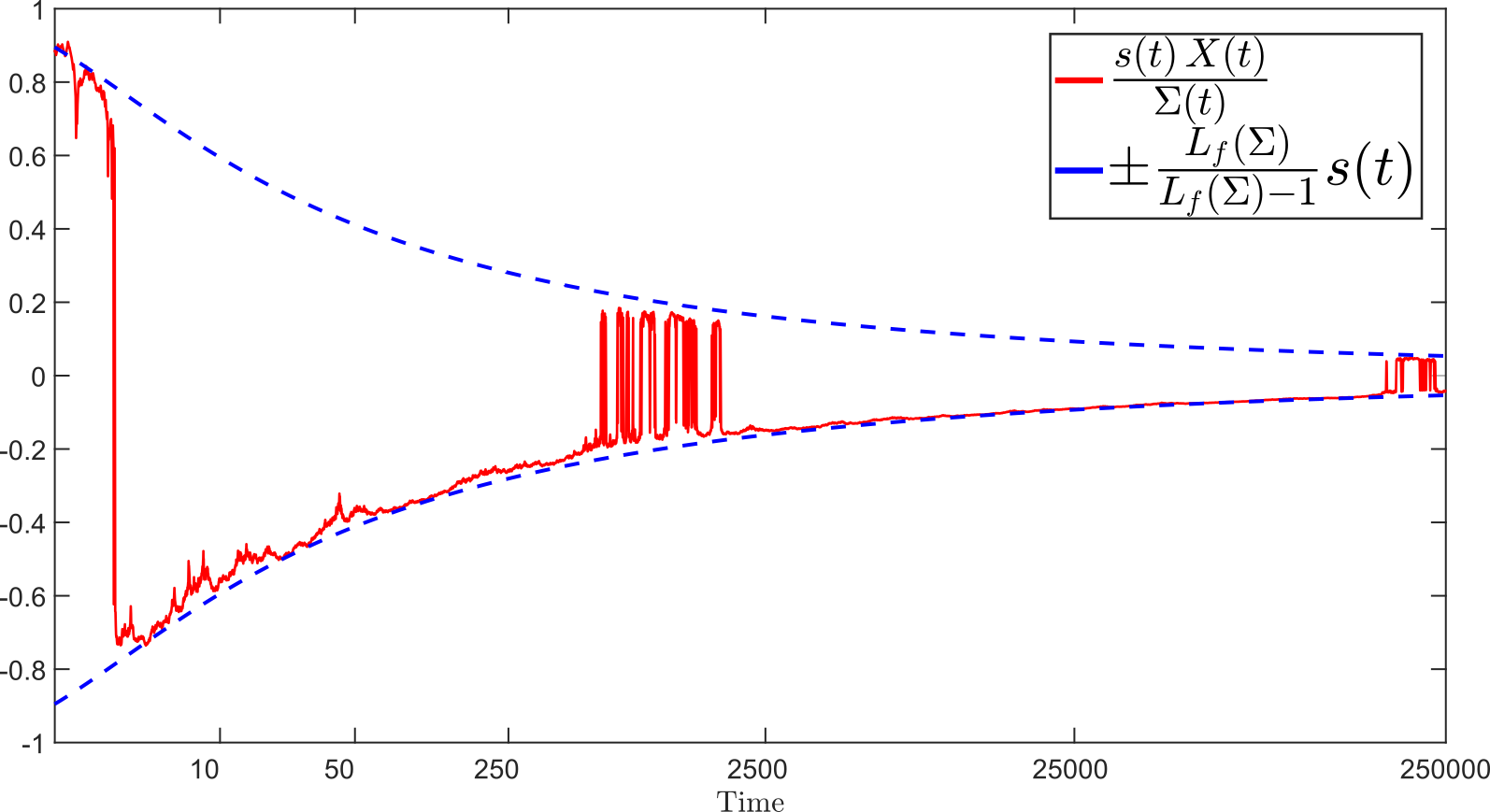
My research lies at the interface of nonlinear dynamics, stochastic analysis, and mathematical modelling. My graduate work examined qualitative properties of nonlinear differential systems with memory and subject to random noise, with a focus on growth rates and blow-up of solutions in both deterministic and stochastic systems. My postdoctoral and subsequent research has applied mathematical methods — including dynamical systems, stochastic particle systems, and partial and integro-differential equations — to interdisciplinary collaborations in ecology, developmental biology, and epidemiology. See the Publications page for a full list of papers.
Mathematical Ecology
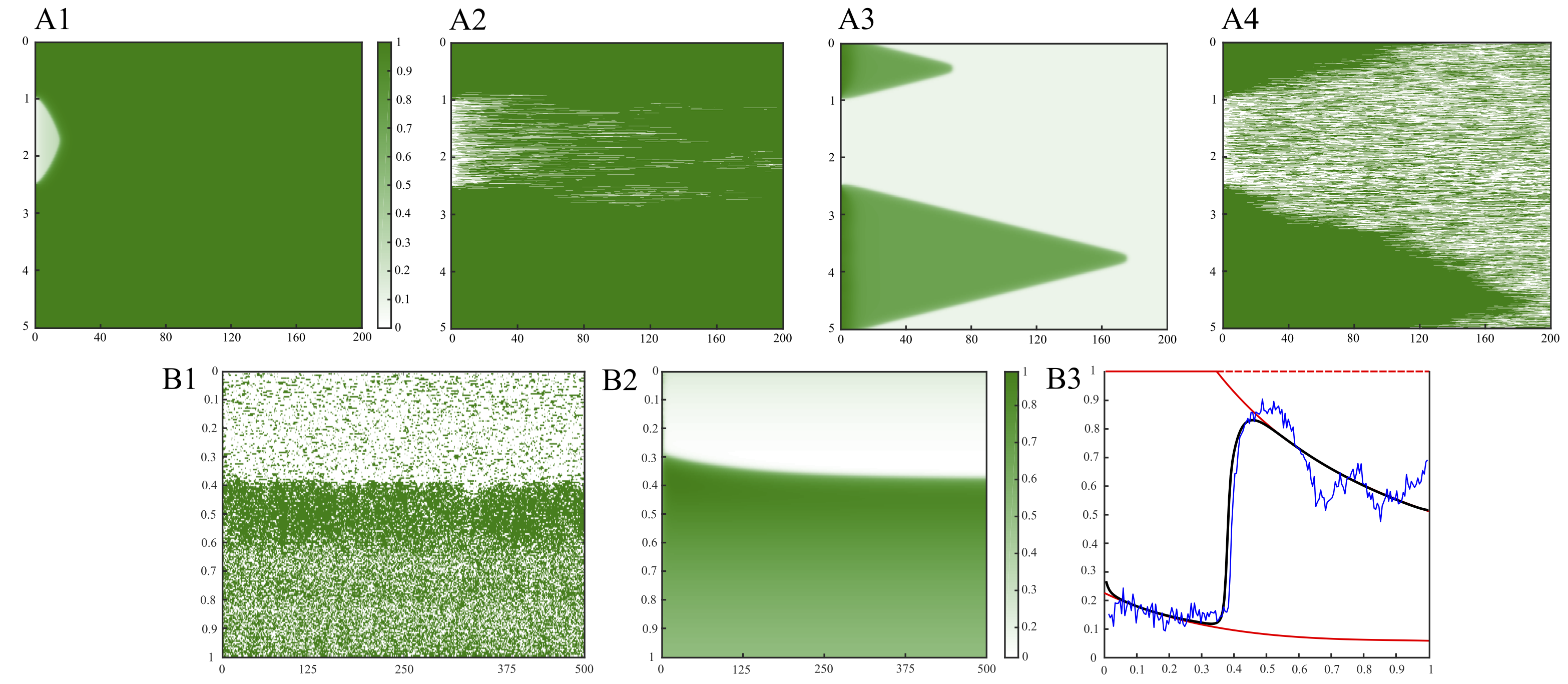
My ecology research focuses on spatial models of vegetation dynamics (especially forest-savanna ecosystems), alternative stable states, and critical transitions (abrupt regime shifts). Central themes are understanding how spatial heterogeneity and noise interact to shape the stability landscapes of ecosystems, and developing early-warning indicators for impending transitions.
Mathematical methods: stochastic interacting particle systems, spatial mean-field theory (propagation of chaos), integro-differential equations (IDEs), bifurcation analysis, pattern formation theory, and non-equilibrium landscape–flux analysis.
Key results:
- Rigorous probabilistic foundations for spatial mean-field models in ecology (SIAM J. Appl. Dyn. Syst., 2020)
- Unification of deterministic and stochastic ecological dynamics via a landscape–flux framework (PNAS, 2021)
- Non-equilibrium early-warning signals for critical transitions in ecological systems (PNAS, 2023)
- Pattern formation and bifurcation structure in forest-savanna systems (Bull. Math. Biol., 2024)
Mathematical Epidemiology: Malaria
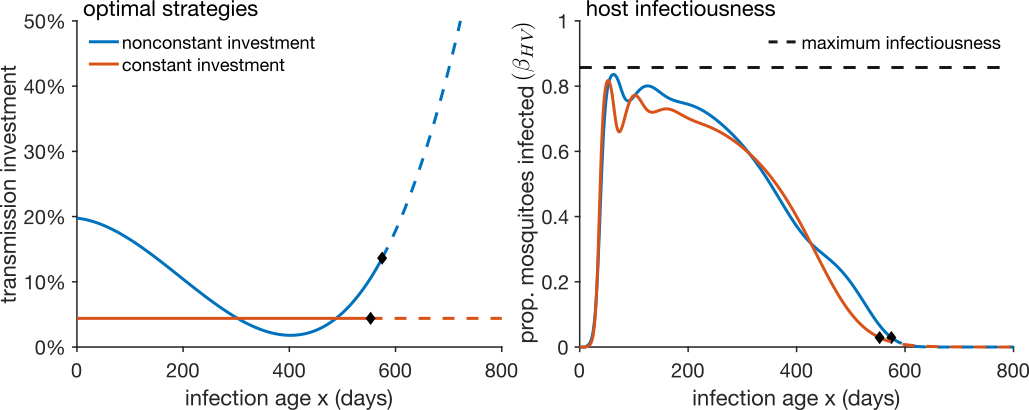
I work on mathematical modelling of malaria at both the population and within-host scales. Using age-structured PDE frameworks, my collaborators and I modelled the accumulation of anti-malaria immunity in humans and its consequences for parasite evolution and vaccine design. In terms of within-host dynamics of malaria, I have worked on the question of how immune pressures shape the evolution of parasite transmission investment.
Mathematical methods: age-structured partial differential equations, within-host PDE-ODE systems with immune dynamics, optimal control theory, evolutionary optimisation (adaptive dynamics), and seasonal forcing.
Key results:
- Age-structured PDE framework for the accumulation of anti-malaria immunity and its consequences for parasite evolution and vaccine design (SIAM J. Appl. Math., 2023)
- Demonstration that acquired immunity imposes a reproduction–survival tradeoff on malaria parasites, shaping the evolution of transmission investment (Evolution, 2026)
- Malaria vaccination model incorporating seasonality and immune feedbacks (PLoS Comput. Biol., 2025)
Functional Differential Equations
My doctoral research studied the qualitative behaviour of Volterra integral and functional differential equations, including the growth and blow-up of solutions in superlinear systems, large fluctuations in stochastic systems, and convergence rates to equilibrium.
Mathematical methods: Volterra integral and integro-differential equations, functional differential equations, Itô stochastic calculus, regular and slow variation, and sharp asymptotic analysis.
Key results:
- Sharp characterisation of growth rates and finite-time blow-up in superlinear Volterra systems (SIAM J. Math. Anal., 2018; DCDS, 2018)
- Precise almost-sure asymptotic bounds on solutions of nonlinear stochastic functional differential equations (Appl. Math. Comput., 2021)
- Classification of convergence rates to equilibrium in perturbed ODEs with regularly varying nonlinearity (Electron. J. Qual. Theory Differ. Equ., 2016)