My interests lie at the intersection of nonlinear dynamics, stochastic analysis, and mathematical modelling. During my graduate studies, I worked on functional differential equations, examining growth rates and blow-up of solutions in both deterministic and stochastic systems with memory. More recently, I have focused on applying mathematical methods to build and analyse models in applications, and I have ongoing interdisciplinary collaborations with colleagues in ecology, developmental biology, and epidemiology. Mathematically, my applied projects involve studying problems in dynamical systems, stochastic particle systems, and partial and integro-differential equations.
Collaborators:
- John Appleby (Dublin City University, PhD Advisor)
- Lauren Childs (Virginia Tech)
- Shen-Ju Chou (Academia Sinica)
- Christina Edholm (Scripps College)
- Megan Greischar (Cornell University)
- Simon Levin (Princeton University, Postdoctoral Mentor)
- Joan Ponce (Arizona State University)
- Olivia Prosper (University of Tennessee Knoxville)
- Zhuolin Qu (University of Texas San Antonio)
- Carla Staver (Yale University)
- Jonathan Touboul (Brandeis University, Postdoctoral Mentor)
- Jin Wang (Stony Brook)
- Li Xu (Chinese Academy of Sciences)
- Lihong Zhao (Kennesaw State University)
Mathematical Ecology
My primary interests in mathematical ecology are spatial models of vegetation dynamics (especially forest-savanna ecosystems), alternative stable states, and critical transitions (abrupt regime shifts).
Understanding the dynamics and stability of tropical biomes, such as rainforests and savannas, is crucial for effective conservation efforts. I am working on rigorously deriving and analysing spatially extended versions of classical models in this domain. Our models aim to more realistically reflect vegetation dynamics by accounting for the spatial structure and environmental heterogeneity observed empirically. Another key aim of this work is to quantify the stability of these ecosystems to noise and parameter shifts, thereby anticipating sudden regime shifts (critical transitions). To this end, we applied the landscape-flux approach from non-equilibrium statistical physics to several well-known model problems (savanna-forest coexistence, lake eutrophication, and vegetation patterning).

K. Shen, S. A. Levin and D. D Patterson, Spatial modeling of forest-savanna bistability: impacts of fire dynamics and timescale separation, Journal of Mathematical Biology, Vol. 92, No. 44 (2026). [Open Access]
L. Xu, D. D. Patterson, S. A. Levin and J. Wang, Global stability and tipping point prediction of the coral reef ecosystem, Earth System Dynamics, Vol. 16, No. 25 (2025). [Open Access]
J. D. Touboul, J. Li, D. D. Patterson and S. A. Levin, New challenges in spatial ecology, Japan Journal of Industrial and Applied Mathematics (2025). [Open Access]
J. Siu, W. Wu, D. D. Patterson, S. A. Levin and J. Wang, Revealing physical mechanisms of pattern formation and switching in ecosystems via landscape and flux, Advanced Science, 2501776 (2025). [Open Access]
D. D. Patterson, S. A. Levin, A. C. Staver and J. D. Touboul, Pattern formation in mesic savannas, Bulletin of Mathematical Biology, Vol. 86, No. 3 (2024). [Open access]
D. D. Patterson, A. C. Staver, S. A. Levin and J. D. Touboul, Spatial dynamics with heterogeneity, SIAM Journal on Applied Mathematics, S225-S248 (2023). [arXiv]
L. Xu, D. D. Patterson, S. A. Levin, and J. Wang, Non equilibrium early-warning signals for critical transitions in ecological systems, Proceedings of the National Academy of Sciences, Vol. 120, No. 5 (2023), e2218663120.
L. Xu, D. D. Patterson, A. C. Staver, S. A. Levin, J. Wang, Unifying deterministic and stochastic ecological dynamics via a landscape-flux approach, Proceedings of the National Academy of Sciences, Vol. 118, No. 24 (2021), e2103779118. [arXiv]
D. D. Patterson, A. C. Staver, S. A. Levin, J. D. Touboul, Probabilistic foundations of spatial mean-field models in ecology and applications, SIAM Journal on Applied Dynamical Systems, Vol. 19, No. 4 (2020), 2682-2719. [arXiv]
Mathematical Epidemiology: Malaria
Malaria is a mosquito-borne disease that causes hundreds of thousands of deaths each year. Individuals acquire immunity of various types from both exposures over time and vaccination. Since malarial impacts vary significantly by age, we constructed and analysed a mathematical model with age structure to assess the impact of immune feedback on disease dynamics. I am also working on within-host dynamics to understand the likely effects of vaccinations on parasite evolution.
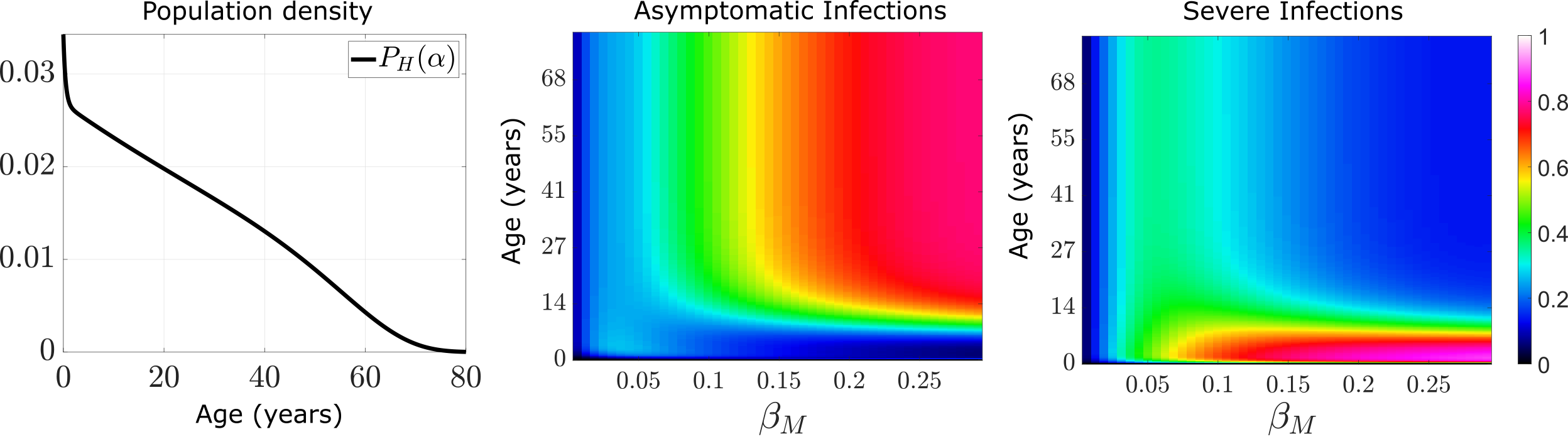
D. D. Patterson, L. M. Childs, I. J. Stopard, N. Chitnis, S. Serrato-Arroyo, and M. A. Greischar. Immunity can impose a reproduction-survival tradeoff on human malaria parasites, Evolution (2025), qpaf238. [Open Access]
Z. Qu*, D. D. Patterson*, L. Childs, C. Edholm, J. Ponce, O. Prosper and L. Zhao, Mathematical modeling of malaria vaccination with seasonality and immune feedbacks, PLoS Computational Biology (2025), 21(5): e1012988. [*equal contribution]
Z. Qu*, D. D. Patterson*, L. Childs, C. Edholm, J. Ponce, O. Prosper and L. Zhao, Modeling immunity to malaria with an age-structured PDE framework, SIAM Journal on Applied Mathematics (2023), Vol. 83, No. 3 (2023), 1098-1125. [*equal contribution, arXiv]
Mathematical Modelling: Developmental Biology
Working closely with experimental collaborators, we developed a novel mathematical model to explain the unexpected formation of ectopic cortical regions in the brains of mutant mice during early development.

J. Feng*, W. H. Hsu*, D. D. Patterson, C. S. Tseng, Z. H. Zhuang, H. W. Hsin, Y.T. Huang, A. Faedo, J. L. Rubenstein, J. D. Touboul and S.J. Chou, COUP-TFI specifies the medial entorhinal cortex identity and induces differential cell adhesion to determine the integrity of its boundary with neocortex, Science Advances, Vol. 7, No. 27 (2021), eabf6808. [*equal contribution]
Functional Differential Equations
Finite-time blow-up of systems with memory
There is a vast body of literature on blow-up criteria for nonlinear Volterra equations, and many results estimate the blow-up time. However, the problem of determining the behaviour of solutions near blow-up is relatively open, and we have addressed this issue for some classes of nonlinear functional differential equations.
J. A. D. Appleby and D. D. Patterson, Blow-up and superexponential growth in superlinear Volterra equations, Discrete and Continuous Dynamical Systems (Series A), Vol. 38, No. 8 (2018), 3993-4017. [arXiv]
J. A. D. Appleby and D. D. Patterson, Growth rates of solutions of superlinear ordinary differential equations, Applied Mathematics Letters, Vol. 71 (2017), 30-37.
Discrete systems with memory
Volterra summation equations are general discrete-time models for processes whose evolution depends on their entire history (e.g. time series models in economics and finance). If solutions become unbounded, it is natural to rescale them, but does this process preserve economically relevant properties? We answer this question for linear equations with both random and deterministic forcing sequences.
J. A. D. Appleby and D. D. Patterson, Large Fluctuations and growth rates of linear Volterra summation equations, Journal of Difference Equations and Applications, Vol. 23, No. 6 (2017), 1047-1080.
Growth rates of systems with memory
The evolution of many phenomena depends not only on their present state but also on their past states. In continuous time, incorporating this dependence leads to the study of functional differential equations (FDEs). These papers investigate how the memory of past states affects the growth rate of such systems and how dynamics are impacted by random and deterministic forcing.

J. A. D. Appleby and D. D. Patterson, Growth and fluctuation in perturbed nonlinear Volterra equations, Applied Mathematics and Computation, Vol. 396, (2021) 125938.
J. A. D. Appleby and D. D. Patterson, Growth rates of sublinear functional and Volterra differential equations, SIAM Journal on Mathematical Analysis, Vol. 50, No. 2 (2018), 2086-2110.
J. A. D. Appleby and D. D. Patterson, Memory dependent growth in sublinear Volterra differential equations, Journal of Integral Equations and Applications, Vol. 29, No. 4 (2017), 531-584.
J. A. D. Appleby and D. D. Patterson, Hartman-Wintner growth results for sublinear functional differential equations, Electronic Journal of Differential Equations, Vol. 2017, No. 21 (2017), 1-45.
Convergence rates of stable solutions
How quickly do solutions to a nonlinear ordinary differential equation with a globally stable equilibrium decay? These papers consider this question for scalar ordinary and stochastic differential equations. The use of the theory of regularly varying functions is a recent theme in QTDE, and we employ regular variation here to prove precise asymptotic results.
J. A. D. Appleby and D. D. Patterson, Classification of convergence rates of solutions of perturbed ordinary differential equations with regularly varying nonlinearity, Electron. J. Qual. Theory Differ. Equ., Proc. 10th Coll. Qualitative Theory of Diff. Equ., No. 3 (2016), 1-38.
 Denis Patterson