The following project proposal is for third-year students taking the mathematical sciences final-year undergraduate project module for the academic year 2026/2027.
Overview and Group Project
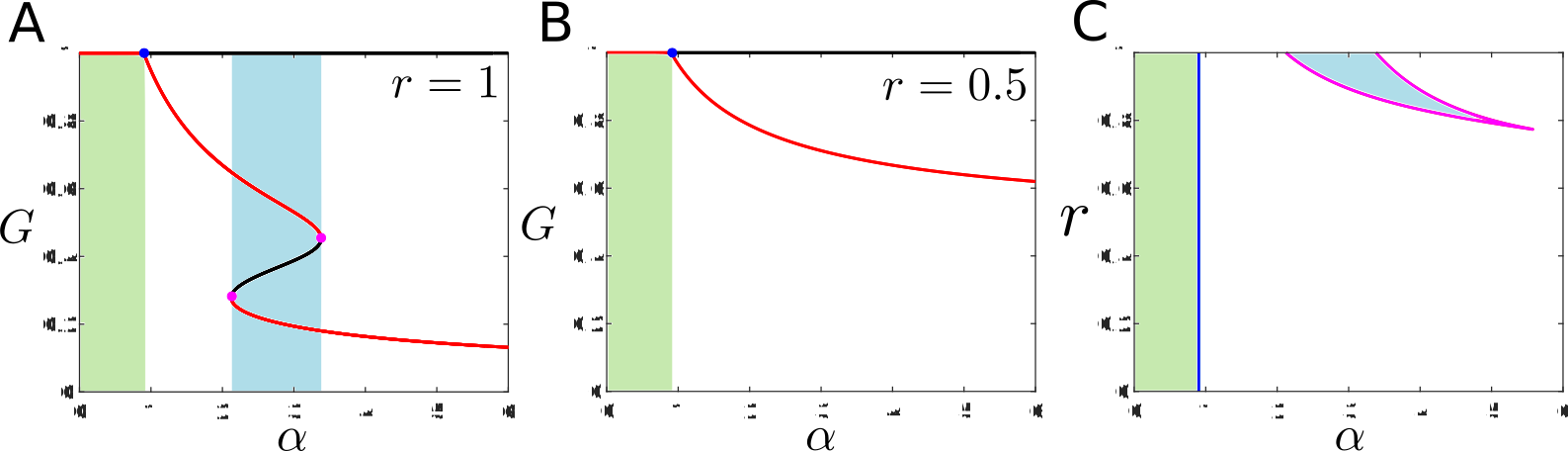
This project explores the theoretical foundations and practical applications of numerical bifurcation analysis, an essential technique for understanding how the qualitative behaviour of dynamical systems evolves as system parameters change. The group phase of the project will focus on the theoretical foundations of bifurcation theory. Students will study fixed points and their stability, and learn how to classify bifurcation types , including saddle-node, pitchfork, and Hopf bifurcations, using techniques from dynamical systems theory. Students will also encounter more advanced objects such as stable and unstable manifolds and homoclinic and heteroclinic connections. A key focus will be on numerical techniques for computing bifurcation diagrams, including pseudo-arclength continuation and deflation algorithms.
Techniques
Students will use a combination of analytical and computational methods:
- Ordinary and partial differential equations and dynamical systems theory
- Fixed points, stability analysis, and linearisation
- Classification of bifurcation types (saddle-node, pitchfork, Hopf)
- Pseudo-arclength continuation and deflation algorithms
- Numerical continuation software (AUTO, MATCONT, or BifurcationKit.jl)
Individual Project
The project’s individual phase will focus on the application of these methods to mathematical models from physics and biology, such as predator-prey models, chemical oscillators, and reaction-diffusion equations. Students will use numerical continuation software (AUTO, MATCONT, or BifurcationKit.jl) to generate bifurcation diagrams and investigate how the qualitative behaviour of these models changes as parameters are varied.
Mode of Operation and Evidence of Learning (group and individual phases)
This project is coding-intensive. Students will read and discuss concepts and present their results in weekly meetings. Students will implement numerical methods and use continuation software (AUTO, MATCONT, or BifurcationKit.jl) to generate and analyse bifurcation diagrams for a range of dynamical systems. They will apply dynamical systems theory, including stability analysis, phase plane techniques, and bifurcation classification, both analytically and computationally. Evidence of learning will be demonstrated through mathematical derivations, computational results, and discussion of the findings through both oral and written formats.
Prerequisites
Students should be familiar with basic concepts in differential equations and dynamical systems. This is a coding-intensive project, and prior programming experience is essential. The project is particularly well suited to students who have taken Computational Mathematics II.
Recommended Reading
- Strogatz, S. H. (2001). Nonlinear Dynamics and Chaos. Westview Press. (introductory text on nonlinear dynamics)
- Seydel, R. (2009). Practical Bifurcation and Stability Analysis (3rd ed., Vol. 5). Springer.
- Veltz, R. (2020). BifurcationKit.jl. [GitHub]