The following project proposal is for fourth-year (MMath) students taking the Mathematical Sciences final-year project module for the academic year 2026/2027.
Overview
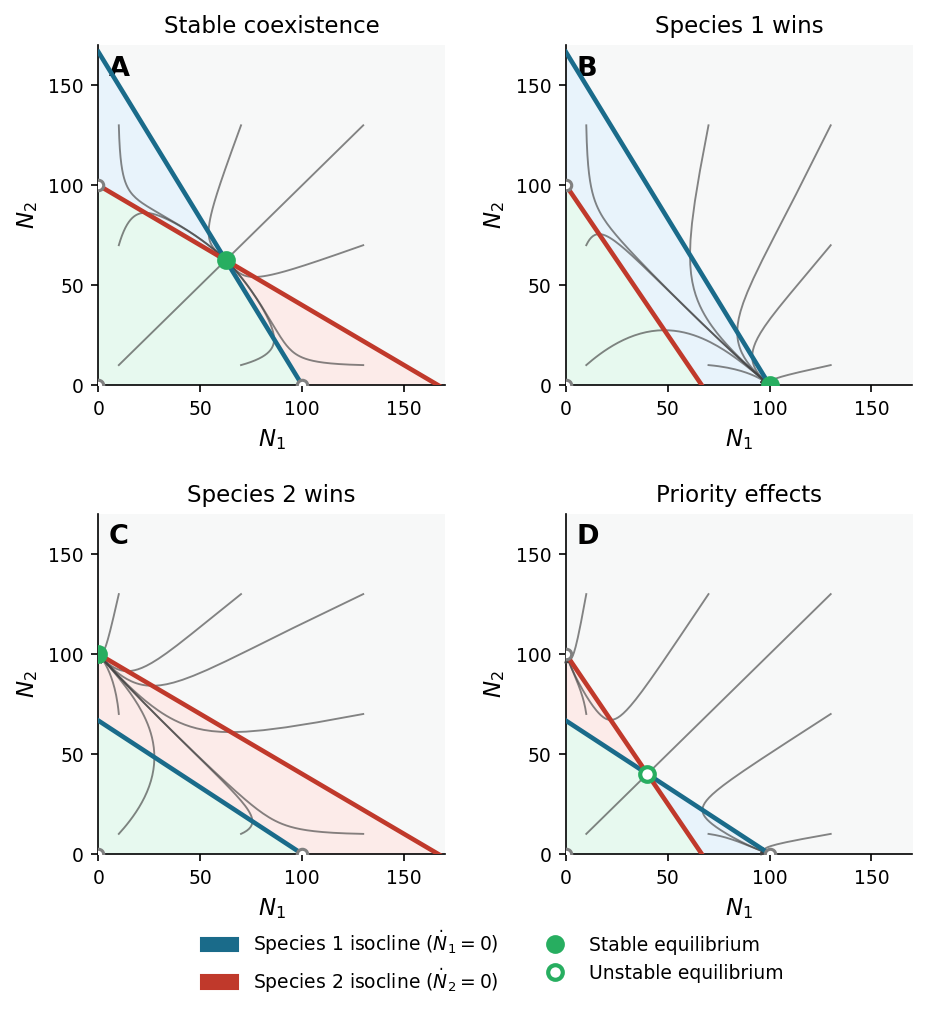
How can hundreds of species coexist when they compete for the same limited resources? Classical ecological theory, the competitive exclusion principle, predicts that two species cannot stably coexist on a single limiting resource; the stronger competitor will always drive the other to extinction. Yet real ecosystems display extraordinary biodiversity. Resolving this apparent contradiction is one of the central challenges of theoretical ecology, and mathematics is at its heart. Questions about coexistence are fundamental in modern research in microbiology, conservation biology, cancer biology, and many other fields.
A central tool in coexistence theory is invasion analysis: a community is said to support coexistence if every species, when introduced at low density into a community of its competitors, has a positive per-capita growth rate, known as the invasion growth rate. This condition translates into concrete mathematical conditions that can be derived and analysed using the tools of dynamical systems theory. Students will formulate, analyse, and simulate ecological models of competing populations to understand when and why these conditions hold.
Among other topics, this project will explore Modern Coexistence Theory (MCT), a powerful mathematical framework that provides a systematic way to decompose and quantify the mechanisms that allow species to coexist. The theory identifies two broad classes of mechanism: stabilizing mechanisms, which strengthen the tendency of each species to recover when rare (niche differentiation, the storage effect, relative nonlinearity of competition), and equalizing mechanisms, which reduce fitness differences between species. Stable coexistence requires that stabilizing effects are strong enough to overcome any fitness inequalities. While powerful, MCT can be challenging to apply to more complex mathematical models and real-world systems, and there are many open research questions about how to extend the theory to more general settings.
Possible directions for the project include:
- Research on mathematical models for systems studied by collaborators in Durham’s Department of Biosciences, e.g. metal-sensitive microbial communities or c. elegans populations.
- How can MCT be extended to more complex models, e.g. with nonlinear functional responses, spatial structure, or temporal fluctuations? Can we derive general mathematical conditions for coexistence in these settings?
- Under what conditions does spatial heterogeneity allow more species to coexist than resources, overcoming competitive exclusion? [PDEs/spatial models]
- Coexistence in large communities via Random Matrix Theory: How do the properties of random interaction networks affect the likelihood of coexistence?
Techniques
Students will use a combination of analytical and computational methods:
- Ordinary and partial differential equations (incl. Lotka–Volterra, resource-competition, and consumer-resource models)
- Invasion analysis and per-capita growth rates
- Phase portraits, stability analysis, and linearisation
- Bifurcation analysis
- Numerical simulations (MATLAB or Python)
Mode of Operation and Evidence of Learning
Students will read modern research papers on coexistence theory and engage with recent developments and open problems in the field, including identifying key research questions and gaps. Key ideas and results from the literature will be discussed in regular meetings, and students will be expected to engage critically with the mathematical arguments in the papers they read.
Students will write code in MATLAB or Python to simulate models, compute invasion growth rates, and visualise the outcomes of coexistence mechanisms across parameter space. They will apply dynamical systems methods, including stability analysis, phase plane techniques, and bifurcation theory, to analyse models both analytically and computationally.
Prerequisites
This project is intended for students with prior coding experience and an interest in research in mathematical biology. Students should be comfortable with concepts and techniques in differential equations and dynamical systems; Mathematical Biology III or demonstrated proficiency in dynamical systems is a required prerequisite.
Recommended Reading
- Strogatz, S. H. (2001). Nonlinear Dynamics and Chaos. Westview Press.
- Chesson, P. (2000). Mechanisms of maintenance of species diversity. Annual Review of Ecology and Systematics, 31, 343–366.
- Barabás, G., D’Andrea, R., & Stump, S. M. (2018). Chesson’s coexistence theory. Ecological Monographs, 88(3), 277–303.
- Kot, M. (2001). Elements of Mathematical Ecology. Cambridge University Press.